




Don’t Forget the Tails: Why Insulating UFH Transit Pipes Is Non-Negotiable
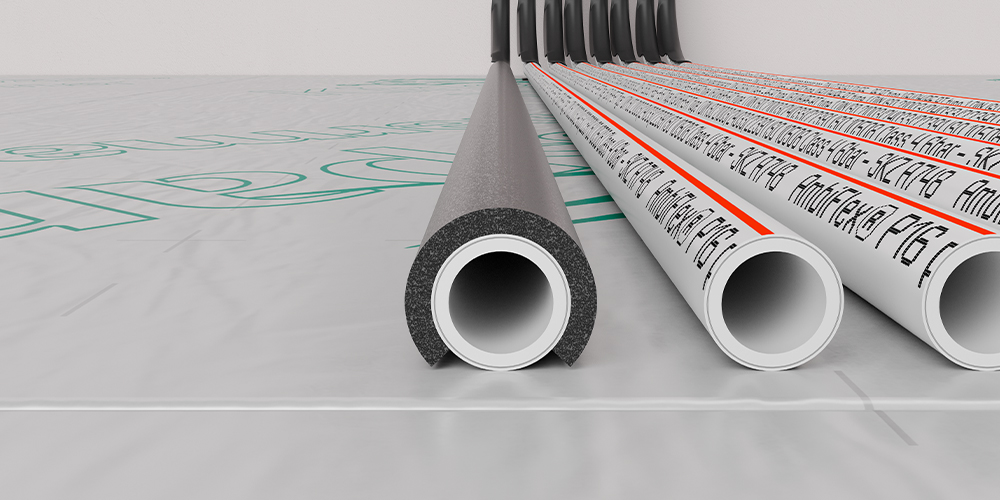
When designing or installing a wet underfloor heating (UFH) system, it’s easy to obsess over pipe layouts and flow rates. But there’s a small detail that can quietly ruin performance, waste energy, and frustrate your client:
Uninsulated transit pipes – also called tail pipes or distribution pipes.
These are the lengths of pipe that run from the manifold to the start of each heating loop (and back again). And if you don’t insulate them? You’re leaking heat, efficiency, and money.
1. Stop Heating Places You Don’t Want Heated
Transit pipes often run through:
- Floor voids or crawl spaces
- Zones that are already insulated
- Areas under furniture or solid walls
- The stretch between manifold and actual heating zones
Without insulation, these pipes act like unwanted radiators. They leak heat into unintended places – reducing efficiency and causing unpredictable results in the heated areas.
2. Cut Running Costs & Boost Efficiency
Every bit of heat lost through a transit pipe:
- Increases boiler or heat pump workload
- Raises the homeowner’s energy bills
- Reduces overall system CoP (especially with heat pumps)
Insulation is a simple, low-cost fix that pays for itself. It protects system efficiency and helps deliver the low-energy heating UFH is known for.
3. Avoid Hot Spots and Overheating
Transit pipes can also cause unwanted heating where it’s not designed to happen. This leads to:
- Hot spots under fixed furniture or thresholds
- Flooring damage (especially with temperature-sensitive finishes)
- System imbalance that disrupts comfort and control
Even if it’s not visible right away, these issues can show up later as complaints or call-backs.
4. Stay Compliant and Avoid Inspection Failures
It’s not just good practice – it’s the law.
In the UK, Building Regulations Part L requires pipe insulation through unheated areas. Plus, standards from CIBSE, MCS, and BS EN 1264 recommend:
- Insulating all pipework in unheated zones
- Preventing unnecessary heat loss through voids
- Maintaining system temperature integrity
Skipping insulation can lead to failed inspections, remedial work, and liability headaches.
5. Maintain System Balance and Comfort
A UFH system is a finely tuned balance of flow rates and temperatures. If water cools before it reaches the floor loops:
- Balancing zones becomes harder
- Flow rates may become unstable
- Rooms heat unevenly, or not at all
Insulating transit pipes keeps things predictable, controllable, and comfortable for the end-user – and headache-free for you.
Key Takeaway
Insulating UFH tail pipes isn’t a ‘nice-to-have’ – it’s essential. It protects system performance, boosts efficiency, and ensures you meet regulations.
Professional tip: Always insulate transit pipes through voids, non-heated zones, and anywhere outside of the active heating area. It’s a small detail that makes a big difference.
Need Help or Guidance?
TailTape is engineered specifically with installers in mind:
- Fast, Self-Adhesive Application: Reduces installation time dramatically compared to traditional methods – no messy adhesives or cumbersome clips.
- Durable, Elastomeric Material: Withstands on-site conditions for long-lasting performance.
- High Mould Resistance (Closed-Cell Structure): Offers reliable protection against moisture.
- Proven 30% Heat Transfer Reduction: Independent testing confirms significant performance improvements, ensuring efficient installations.
For technical data and more information, visit the TailTape product page or download the TailTape datasheet:
Simple, Fast Installation
We recommend applying TailTape to all flow and return pipework between the manifold and heating zones to minimise the dispersion of heat until it reaches the desired area to be heated. The process is straightforward: Simply clean the pipework, apply the tape with a slight overlap, and you’re done. TailTape is suitable for use on our AmbiTak and AmbiClip screeded underfloor heating systems.
Proven Performance You Can Trust
Independent testing confirms that TailTape reduces heat transfer by 30%, outperforming traditional split conduits, especially in the case the screed can flow inside the split conduit and result in very little if any thermal insulation.


