




Underfloor Heating Controls: Best Options For Installers
More and more people are beginning to recognise the increased benefits that underfloor heating (UFH) can offer, which has led to its huge increase in popularity over the last few years.
UFH has many advantages against other heating options like radiators such as being more energy-saving, greater design freedom and a more comfortable, even heating method.
Choosing the best UFH Thermostat
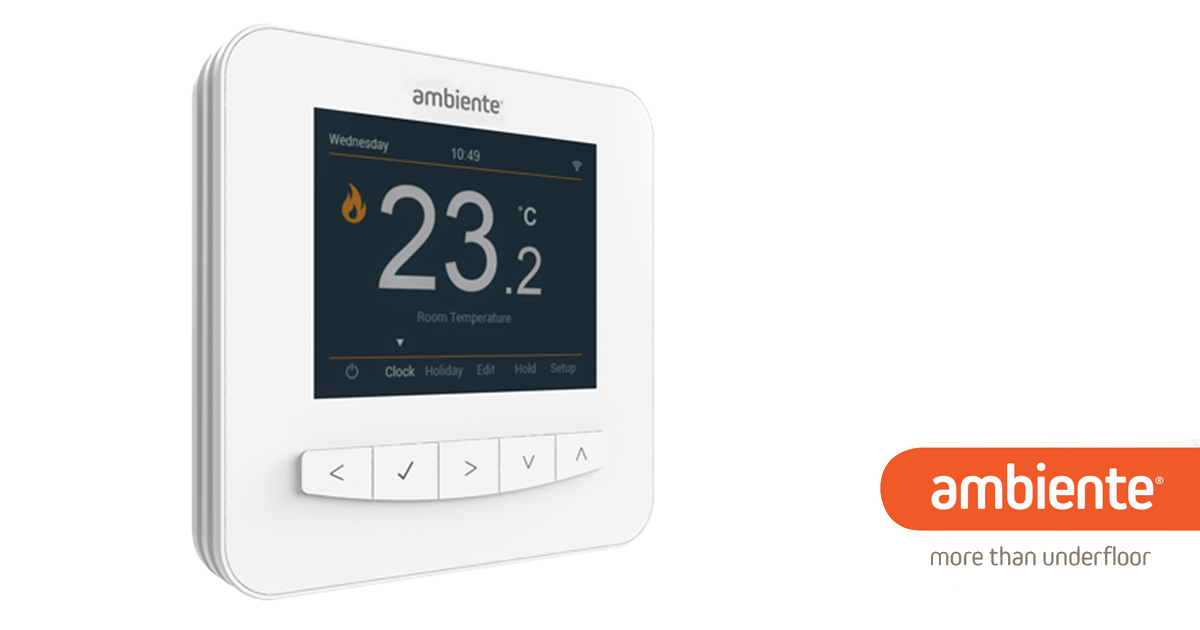
The main component for the control of UFH is the thermostat – this is situated in each heating zone, monitoring the heat in each area, and signalling more heat to be sent to the area as necessary.
It is necessary for the thermostat to be situated in the heating zone, unless a remote air sensor is used, allowing the thermostat to be hidden from view. The thermostat has a built-in air sensor to monitor the heating zone and keep it up to temperature.
Care needs to be taken in wet areas such as bathrooms, where regulations stipulate that mains-voltage devices are not to be installed within these zones. In these situations, the thermostat would be mounted outside of the bathroom, with the heating zone monitored by a remote sensor probe, installed in the floor or wall of the bathroom.
Wireless thermostat options are also available for refurbishment projects, where running new cables would be too intrusive. These thermostats run off batteries, which typically need changing every 12 months.
In some instances, a specialist BMS (Building Management System) is installed, which is typically a multi-functional control system incorporating control of the heating, cooling, lighting, audio/visual etc. In this case, we would typically just supply actuator valves for the manifold, which would be wired into the BMS interface unit.
UFH Thermostat Problems and Solutions
However, one of the main advantages of UFH can also be one of the greatest problems – the control of the system. The benefit in this regard is that individual zones can be controlled separately, resulting in the perfect balance of temperature between the various zones in your home. This means that only areas needing heating are on, the other areas can be set back to a lower temperature, for greater overall efficiency.
Probably the greatest problem around the control of UFH is an understanding of how it differs from conventional heating methods i.e radiators. The main difference in terms of the heating behaviour is the length of the response time – radiators can be warm in a matter of minutes, whereas UFH within a screed floor can take an hour or more to warm up.
This means that the control of the UFH system needs to allow for this longer warm-up and cool-down time. If an area needs to be a certain temperature by a certain time, the UFH system needs to be heating up a long time in advance of this. Or, in reality, the system runs pretty much all the time, warming up slightly when the area calls for heat. Having your UFH system running all the time is not as costly as it sounds – it is much more efficient to have it running at a lower temperature all of the time than ramping up and down on heating demand.
+ Did you find this article helpful?
If you found this guide helpful, be sure to check out our other blog posts for more tips, insights, and expert advice on all things underfloor heating.
+ Any questions on Underfloor heating controls?
If you would like more guidance on underfloor heating, get expert advice from our team at sales@ambiente.co.uk or by calling 01707 649 118
+ Not an Ambiente accreditied installer yet?
Benefit from a wide range of UFH systems and controls to suit every project, gain project leads from our extensive network of contacts and technical support from a highly knowledgeable expert team.
This article was written by Robert Tuffin.
Robert is the General Manager at Ambiente and has been working in the underfloor heating industry since 2012.


