




UFH + Heat Pumps – From Policy to Performance
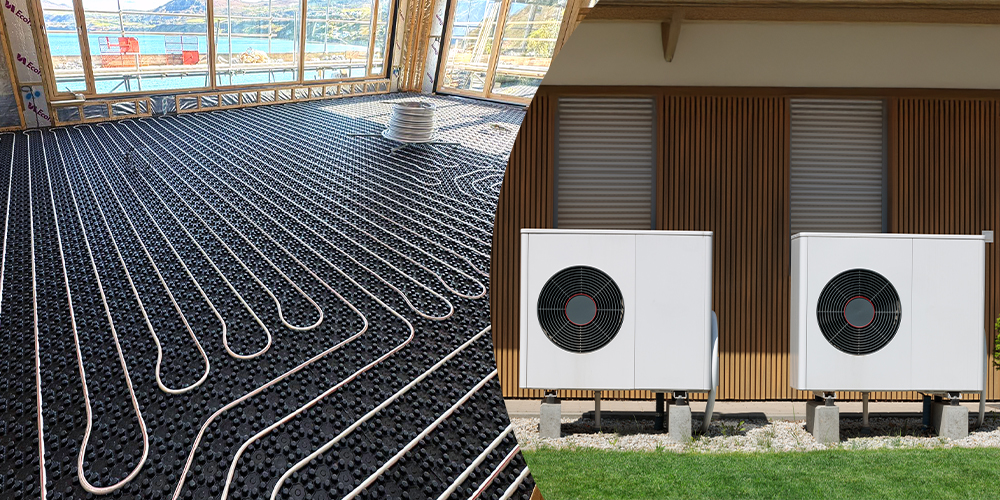
How to specify emitters, controls and construction details which protect COP – and occupant comfort.
Record UK heat-pump growth and the drive to low-temperature heating under Building Regulations mean emitter choice is now a performance decision, not an afterthought. Wet underfloor heating (UFH) is the most straightforward route to 35-45 °C flow temperatures with dependable heat output – if designed, coordinated and commissioned correctly.
Why this matters now
- Policy – practice. The 2021 uplift to Approved Document L tightened energy outcomes and raised the bar for controls and zoning. The industry interprets this as designing wet space-heating systems to operate effectively at ~55 °C max flow (lower where feasible). UFH’s large emitter area is purpose-built for this regime.
- Market momentum. The Boiler Upgrade Scheme (BUS) supported 49,136 low-carbon heat systems by March 2024 (97% ASHP), while MCS reported a record ~39,000 certified heat-pump installations in 2023 (+43% YoY). That’s a design signal, optimise emitters for low flow temps.
- The skill imperative. This rapid growth highlights a critical challenge. the installer skill gap. A perfect design can fail without competent installation and clear coordination between trades.
Design at 35-45 °C. what changes
- Heat loss first, room-by-room. Calculate to BS EN 12831 (and note MCS’s move to the 2017 edition for designs from mid-2025). This sets realistic room loads which determine pipe spacing, manifold sizing and control strategy.
- Pipe spacing linked to load. As room-specific W/m² rises, you tighten spacing or consider higher-output assemblies. The Heat Emitter Guide provides indicative pipe spacing bands for screed and aluminium-plate UFH at 35–55 °C flow.
- Floor build-ups which protect output. For screed systems, respect BS EN 1264 thermal output assumptions and BS 8204/BSRIA guidance on screed depths, curing and commissioning to achieve design conductance.
- Controls which protect COP. Weather/load compensation and room zoning are now the norm under Part L and Boiler Plus (for combi replacements). Weather compensation controls stabilise flow temperature and reduce cycling of the heat pump, especially at low ΔT.
What “good” looks like at emitter level
- Screed UFH (staple or rail). For typical dwelling rooms with specific heat losses <50 W/m², 200–300 mm pipe centres at 35-45 °C flow usually meet design outputs with excellent comfort uniformity.
- Aluminium-plate UFH (dry/joisted floors). Plates reduce thermal resistance and improve responsiveness. Performance assumptions for plate systems are captured in the Emitter Guide. Installation of plates must be in good contact with the floor and avoid air gaps.
- Finishes. Keep floor-finish R-values modest (tiles/engineered timber over suitable underlay) to preserve output. BS EN 1264 caps typical occupied-zone surface temperatures at ~29 °C.
Commissioning
Flush, dose, filter per BS 7593.2019 (lifetime water quality).
Screed warm-up per BS 8204/EN 1264-4 before any floor finish. then verify ΔT and zone balance at design conditions.
Clear project coordination. Ensure the plumber, screeder. And flooring contractors work to a single, coordinated plan to avoid on-site conflicts.
Quick checklist for site packs
- Room-by-room heat-loss calc (BS EN 12831) & manifold schedule.
- Pipe-spacing drawing keyed to W/m² bands (HEG table).
- Control strategy. weather compensation + room thermostats/actuators (Part L).
- Commissioning log. flushing/chemicals, pressure test, photos (Part L evidencing).
Need help or have questions?
Contact our technical team today – your perfect UFH system is just a conversation away.
Contact us today to speak with our team or request a quote.
Explore our UFH systems to see what makes Ambiente different.


