




Supporting Sustainable Architecture with Advanced UFH Solutions under the Future Homes Standard
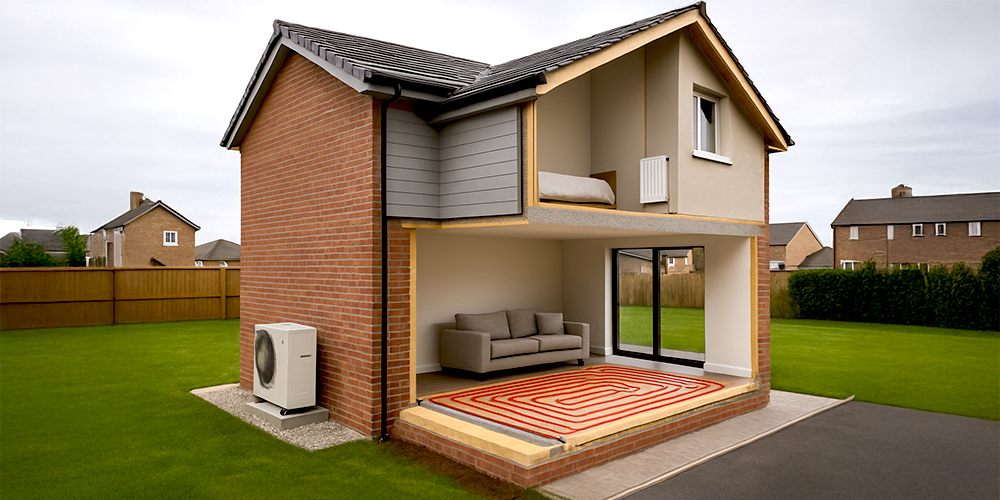
Future Homes, new model: where UFH earns its keep
The Future Homes Standard (FHS) is pushing new homes towards low-carbon heat and higher-performing fabric. At the same time, the Home Energy Model (HEM) will replace SAP with a more rigorous view of heat loss, emitters and control.
In that context, underfloor heating designed for low flow temperatures and backed by credible room-by-room calculations – becomes a powerful compliance tool. It helps hit targets, frees up wall space for better layouts and builds in future-ready climate control, including cooling.
FHS & HEM. the compliance context for emitters
- FHS steers new homes to low-carbon heat and “zero-carbon-ready” fabric. Drafts and consultations point to 2025 publication and alignment with HEM’s first version.
- HEM targets more physics-grounded modelling than legacy SAP. That amplifies the value of accurate heat loss and emitter data – the bedrock of UFH spec.
Design moves which pay off in HEM
- Fabric first, emitter second. Better U-values and airtightness lower room W/m². you then widen pipe spacing and/or reduce flow temperature – both advantageous for heat-pump efficiency and comfort.
- Low-temp by design. Use UFH layouts which hit setpoints at 35-45 °C flow where feasible. This builds in resilience if the heat source changes.
- Space quality & accessibility. UFH frees wall area for layouts and furnishings and supports uncluttered interiors – useful when compliance pushes higher glazing ratios which demand careful overheating mitigation.
Don’t ignore overheating (Part O + TM59)
- UFH doesn’t “cause” overheating. the risks are primarily solar gains and ventilation strategy. However, it can be a key part of the solution.
- Mitigation. Use TM59 for risk assessment alongside Approved Document O. Consider thermal mass, shading. And purge ventilation.
- Active Cooling. With a reversible heat pump, UFH can provide radiant cooling. Circulating chilled water (16-19°C) turns the floor into a comfortable, efficient cooling surface. This requires dew point control in the specification to prevent condensation.
Acoustic Performance in Multi-Storey Buildings
For apartments and multi-storey homes, the floor build-up must meet the acoustic requirements of Approved Document E.
- Impact Sound. A standard UFH build-up can affect impact sound transmission. Specify a combined thermal and acoustic insulation layer designed and tested to meet the regulatory requirements, ensuring comfort is not created at the expense of noise.
Delivery playbook for housebuilders
- Standard details. UFH build-ups (screed and plate) with pipe spacing bands tied to room heat-loss tiers and common floor finishes.
- Controls. Room-by-room thermostats/actuators and weather compensation to meet Part L expectations.
- Evidence pack. Installation photos, insulation continuity. And commissioning logs.
Need help or have questions?
Contact us today to speak with our team or request a quote.
Explore our UFH systems to see what makes Ambiente different.


